Let’s talk about enrollment. This comes up as a topic every election season, so let’s get into it.
The enrollment we have in Eastern Carver County Schools is a function of two things: first, the number of available students and second, the number of those available students that choose to enroll in ECCS and the number of students we can get to open enroll into the district.
I’m going to break this down into four sections over a couple of posts:
- ECCS current enrollment status
- Demographic trends
- Competition and what ECCS is doing to keep students in the district
- What are the practical implications of growing or declining enrollment?
Let’s explore the first two sections today.
#1 – Current Enrollment Status
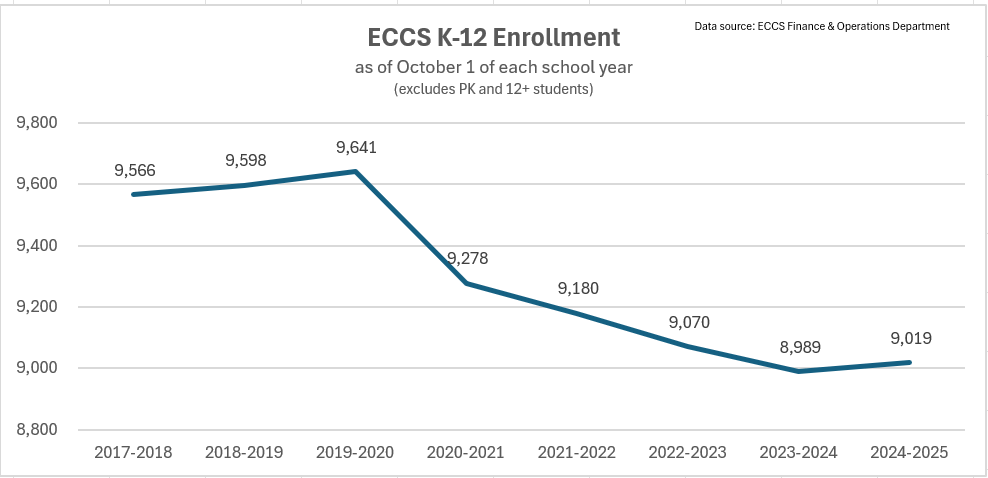
As of October 1, 2024, K-12 enrollment in Eastern Carver County School was 9,019. This is an increase of 30 over last year. It is also about 30 students higher than budget and about 110 students higher than the February 2024 projection.
However, as is frequently noted, this reflects a decrease in enrollment of 622 students from our district’s peak in the 2019-20 school year. About 60% of that decline in enrollment occurred in the 2020-2021 school year, while ECCS was still subject to the Governor’s emergency order.
#2 – Demographic Trends
There have been significant demographic changes in our community that make the enrollment picture more challenging. Let’s look at some data from the Census Bureau to demonstrate (all of this data is available at census.gov). A couple of caveats up front: first, I’m going to use the populations of Chaska, Chanhassen, Carver, and Victoria as a proxy for the population of the school district. We know parts of those four cities go to other districts and there are areas of the townships that attend ECCS. Second, because the Census Bureau breaks up population by “under 5” and “under 18”, we’re going to use the difference of those populations – children aged 5-17 – as a proxy for the number of school-age children in the district. What you should focus on is not the exact numbers per se, but the trends these numbers indicate.
From 2010 to 2020, the overall population of the four cities increased by 18%. Sounds great, right? Dig deeper, however, and you’ll find that the school-aged population only grew by 4% over that period. And for children under the age of 5, population growth was only 1% over the course of the decade.
What does this tell you? It indicates three big factors:
- Birth rates are slowing dramatically: Looking at American Community Survey (ACS) data from the Census Bureau, it shows that the birth rate in our four cities fell over 25% from 2012 (48.5 births per 1,000 birthing-age women) to 2022 (35.7 per 1,000). In fact, the absolute number of births was over 18% lower in the 2022 ACS than it was in 2012 despite the birthing-age population growing by 12% over that time.
- The population that is moving into the district has fewer school-age children than before: One need only look around to see the significant shifts in new housing construction in the area – more apartments and more senior living. These types of housing tend to have markedly lower rates of school-age children than single-family homes.
- Housing affordability is having an impact as well: What else are we seeing? Well, the dramatic increase in home prices is creating its own set of issues. First, we are seeing more “aging in place” – that is, empty nesters staying in their single-family homes after their kids have moved away because it would be too expensive for them to downsize in the current market. Second, the high price of new single-family housing means we’re seeing more older families in those neighborhoods.
All of this together means that our district – despite the overall population growth in the area – is seeing a stagnating or even in some years a declining population of school-age kids to draw from compared to the size of graduating classes. In the next part, I’ll discuss how ECCS is competing with other public and non-public options and discuss what the practical implications are of our current enrollment situation.





 seanolsen.org